









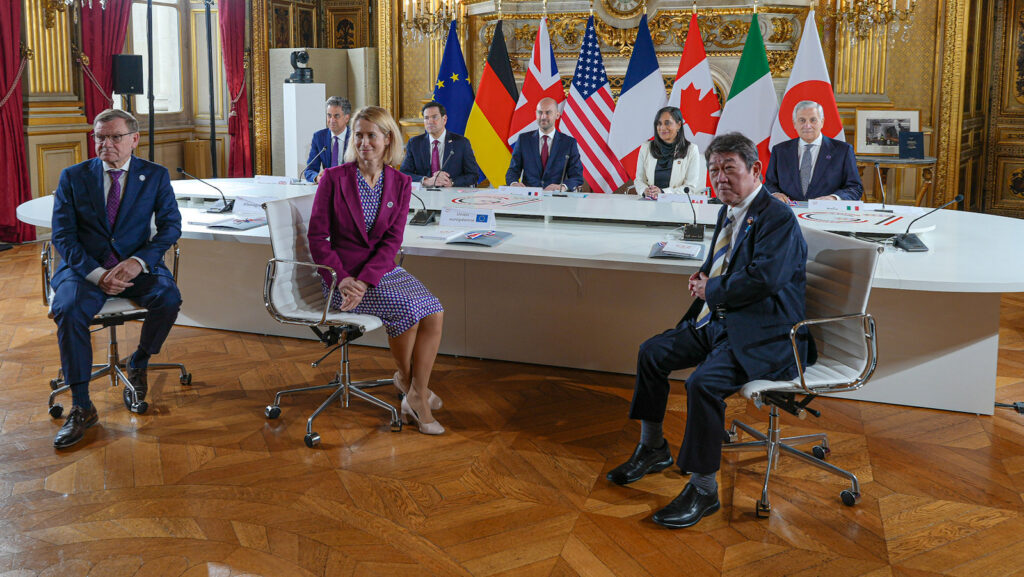
The joint declaration issued after the G7 foreign ministers’ meeting in Paris on November 9 and 10, 2026, recognized online scams as “a form of rapidly growing transnational organized crime that poses a threat to regional and international peace and security.” Ministers stressed the need to strengthen collaboration, “including with the private sector, as appropriate,” and to disrupt scam networks. For banks, payment providers, online platforms and telecom carriers, the language signals that governments see them as part of the response.
From consumer harm to security issue
Placing scams in a foreign ministers’ text, under the heading of transnational organized crime, treats them as a security matter as well as a consumer-protection one. The declaration says scam networks “may be linked to other forms of transnational organized crime.” The same section expresses concern about the growing sophistication, violence and reach of criminal groups involved in drug trafficking, human trafficking and migrant smuggling.
Elsewhere in the text, ministers reaffirmed their concern about “cryptocurrency thefts and cybercrimes committed by North Korea,” and condemned malicious cyber activities as part of wider hybrid campaigns against G7 members and partners.
What the text asks of business
The declaration does not place obligations on companies. It does not set out data-sharing mechanisms, reimbursement rules or platform duties, which remain matters for national law and regulators. Its call for collaboration “as appropriate” leaves the form of private-sector involvement open. The approach matches other parts of the same declaration: on undersea cable repairs, for example, ministers also encouraged practical cooperation with industry rather than setting rules.
Related work is under way in the G20 finance track. The Financial Stability Board’s 2026 progress report on the G20 cross-border payments roadmap, published November 16, calls payment fraud “a growing concern.” It records private-sector concern about a lack of clarity on whether payment transaction details may be shared, and describes a project assessing whether fraud patterns can be shared across borders in a common language.
What comes next
France’s G7 presidency calendar lists a meeting of G7 interior ministers on November 20 and 21. That meeting brings together the ministers responsible for policing and internal security, and it is the next ministerial opportunity before the French presidency ends for the scams language to be turned into more specific commitments.
Companies running fraud-prevention programs across several G7 markets will want to track whether interior or justice ministers agree on channels for information-sharing with industry, and how any such arrangements would interact with national privacy and banking-secrecy rules.
Sources
- France Diplomatie: Joint declaration following the G7 Foreign Ministers Meeting in Paris on 9 and 10 November 2026
- U.S. Department of State: Joint Statement on the G7 Foreign Ministers Meeting in Paris
- Élysée: G7 Évian 2026 presidency schedule
- Financial Stability Board: G20 cross-border payments consolidated progress report for 2026 (November 16, 2026)







