







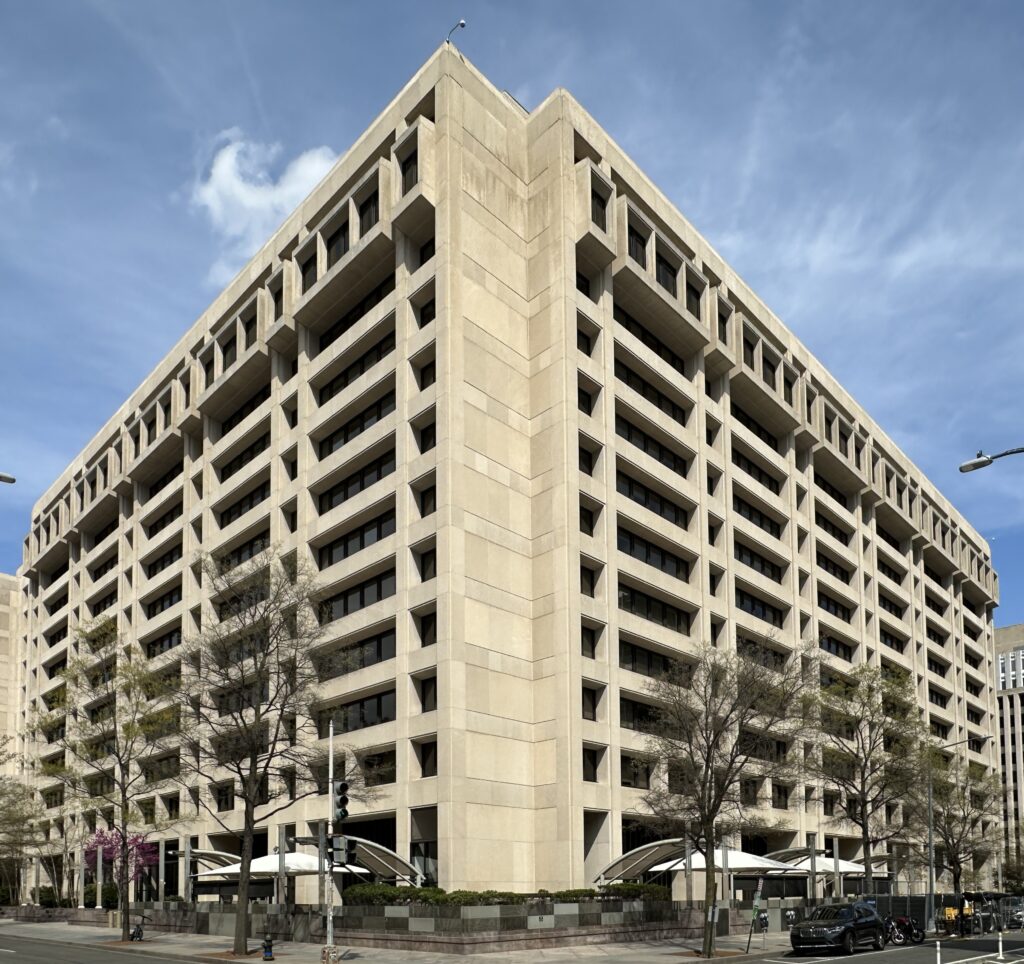
The International Monetary Fund released its October 2026 World Economic Outlook on October 13 at the Annual Meetings in Bangkok, two days before G20 finance ministers and central bank governors meet there under the U.S. presidency. Titled “Resilience Under Strain, Urgent Choices,” the report gives ministers, and the business leaders preparing recommendations for the B20 USA Summit in November, a picture of slower growth, higher inflation and thinner buffers.
The forecast
The IMF projects global growth will slow to 3.1 percent in 2026 and rise to 3.4 percent in 2027. It expects global headline inflation to climb to 4.7 percent in 2026 before easing to 4.1 percent in 2027. The Fund credits the technology upturn, policy buffers and private-sector adaptation with limiting the damage from the war in the Middle East and other geopolitical disruptions. It says energy-importing economies outside the technology value chain face the most difficult outlook.
The IMF describes the risks as tilted to the downside. It lists further escalation of conflicts, a reassessment of expectations about artificial intelligence, renewed trade tensions and fiscal vulnerabilities. On the upside, stronger AI investment and productivity gains, or a sustained easing of geopolitical and trade tensions, could lift growth. The forecast assumes the conflict does not escalate further and energy markets gradually normalize.
Corporate tax and investment
Chapter 3 examines spillovers from corporate income taxation. The IMF finds that anti-avoidance rules have weakened incentives to shift profits, while real investment has become more sensitive to differences in tax rates. It also finds that debt-financed corporate tax cuts support domestic activity but can generate negative spillovers abroad in the short term. Over time those spillovers can turn positive through cross-border knowledge transfer, but lower revenue can constrain public investment, particularly in emerging market and developing economies.
That finding bears on the B20 USA agenda. The U.S. Chamber of Commerce, which hosts the B20 this year, has said its task forces will focus on removing barriers to investment. Companies deciding where to place plants, data centers and supply chains are the actors whose choices the IMF says now respond more closely to tax differences.
Cost-of-living policy
Chapter 2 reviews how governments responded to food and energy price surges over the past five years. It finds that targeted, temporary transfers offer the most cost-efficient protection for vulnerable households while allowing prices to adjust. Measures that suppress prices can require 3 to 22 times more fiscal resources and may lose effectiveness when many countries adopt them at once. For energy-intensive industries, the IMF’s advice is to preserve price signals and rely on targeted support.
Ministers meet in Bangkok on October 15. The B20 USA Summit follows on November 9 to 11 at The Wharf in Washington.
Sources
- International Monetary Fund: World Economic Outlook, October 2026, Resilience Under Strain, Urgent Choices
- Banca d’Italia: World Bank, IMF, G7 and G20 meetings in Bangkok, Thailand
- U.S. Chamber of Commerce: Business leaders from Citadel, Dow, GE Vernova and Amazon to lead B20 USA task forces
- U.S. Chamber of Commerce: B20 USA 2026







