







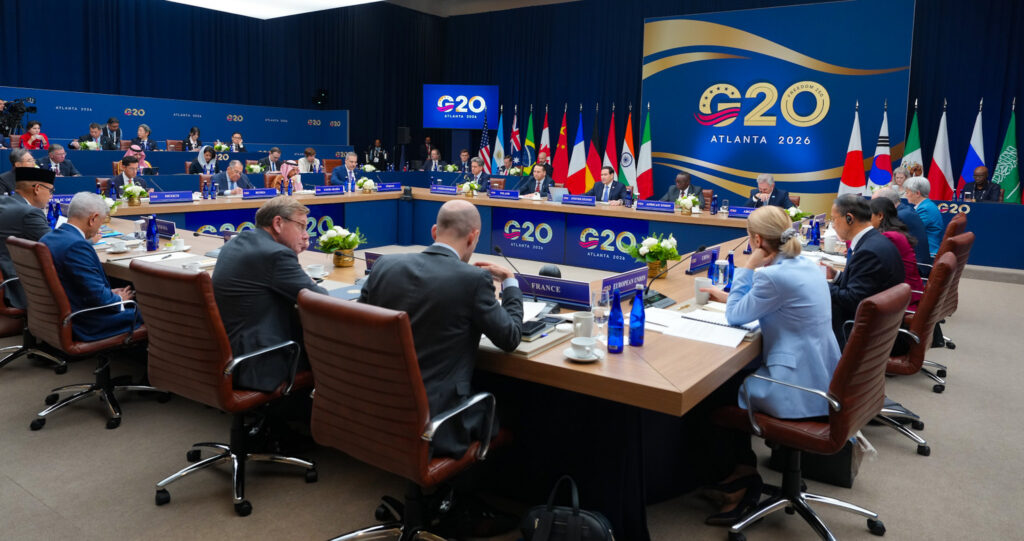
G20 foreign ministers left Atlanta with new language against the use of food as a coercive tool and no agreement on the Black Sea route where that concern is most acute. Secretary of State Marco Rubio said proposals from Türkiye and India are under review. For grain traders, fertilizer producers, shippers and insurers, the gap between the text and the proposals is the story.
This site previewed the shipping and food agenda on October 28. What is new is the outcome: a chair’s statement, published October 31, and Rubio’s account of where the Black Sea talks stand.
Two texts with different standing
The chair’s statement says the weaponization of food supply chains is “an increasingly frequent challenge within the trading system.” It says trade in food and agricultural products should not be used for economic or political coercion. It is the chair’s text and does not record agreement.
The stronger authority sits in Milwaukee. G20 trade ministers issued a statement after their September 30 and October 1 meeting condemning food weaponization. The U.S. chair said “the entire G20” reached consensus on it. That text also covers agricultural inputs, and it excludes transparent measures that serve legitimate domestic policy goals, including food security. The Atlanta statement does not carry that carve-out.
Where the Black Sea stands
Rubio said Türkiye and India had come forward with ideas on moving grain shipments. He said the United States was examining proposals Türkiye sent a week or two before the meeting. Asked about a limited ceasefire covering grain and shipping, he declined to call it momentum, describing instead growing interest in acting as guarantors or facilitators.
He said such an arrangement would not end the war but would reduce its spillover on the food security of vulnerable countries. He said the African continent in particular was paying a high price. UkrAgroConsult, an agricultural trade publication, reported that the meeting produced no maritime ceasefire mechanism.
Why the sea lanes are linked
The chair’s statement ties food to energy flows. It calls secure and uninterrupted energy transit, including safe navigation through international waterways, essential to economic stability. Ministers discussed the Strait of Hormuz and the Bab al-Mandab. Rubio said disruption to energy, fertilizer and farm goods threatens food security. He said members were aligned on the seriousness of the problem but not on how to solve it.
Rubio said fuel volumes through the Strait of Hormuz are now comparable with prewar levels, but that ships are being defended from drones and missiles almost nightly. He said other countries had offered very limited cooperation in protecting that shipping.
Companies should watch two points before Miami: whether leaders restate the Milwaukee consensus, and whether the Turkish and Indian proposals become a concrete mechanism.
Sources
- U.S. Department of State: G20 Chair’s Statement, G20 Foreign Ministers’ Meeting
- U.S. Department of State: Secretary Rubio at a press availability, Atlanta
- USTR: G20 Trade Ministers’ Statement on the Weaponization of Food through Coercive Trade Actions (PDF)
- USTR: Chair’s Statement of the G20 Trade Ministerial
- G20 Miami 2026: U.S. presidency site
- UkrAgroConsult: G20 meeting ends without agreement on Black Sea shipping security







