







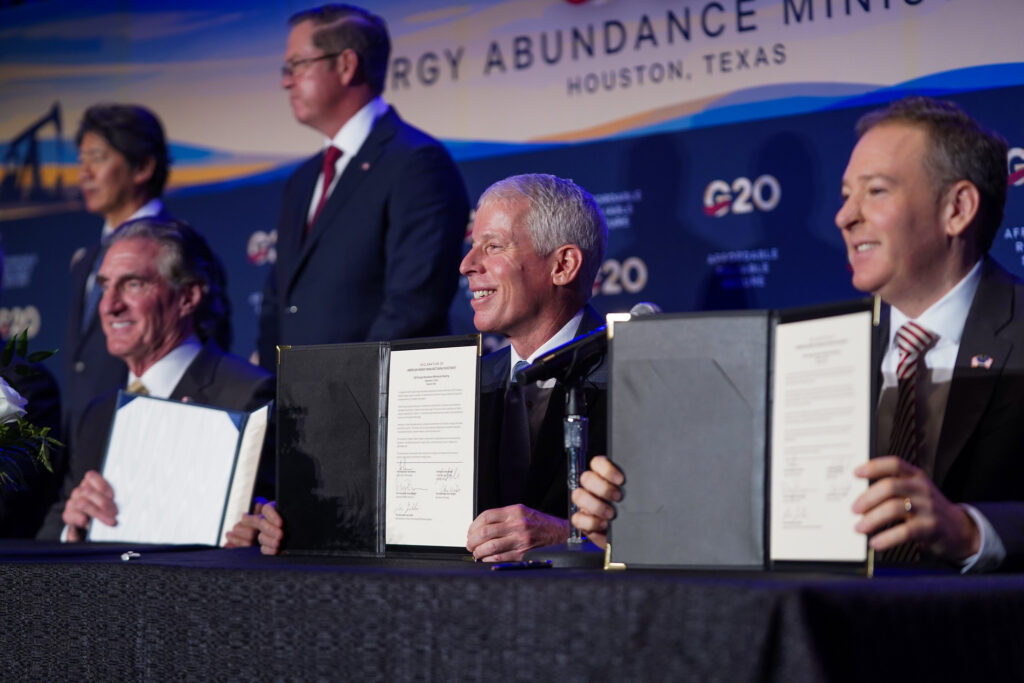
G20 energy ministers have asked finance and development institutions to widen access to funding for clean cooking, and to include liquefied petroleum gas (LPG) projects. The request is the first pillar of the outcomes from the Energy Abundance Ministerial that the U.S. presidency hosted in Houston on September 14 to 16, 2026. The White House said ministers reached consensus on deliverables that include the use of LPG “where it is a reliable and scalable means of rapidly displacing traditional biomass.”
For energy companies, equipment makers, distributors and lenders active in emerging markets, the statement sets out what G20 ministers want from the finance side: fair financing terms, predictable domestic rules and stronger last-mile supply chains.
What the statement says
The statement on advancing clean cooking access says there is no single pathway to clean cooking. It says local context and each country’s choices on its energy mix should determine the right portfolio of solutions.
It gives particular weight to LPG. According to the statement, LPG “has accounted for roughly three-quarters of gains in global clean cooking access since 2010,” and for 75 percent of gains in sub-Saharan Africa since 2018. It also points to electric cooking, noting that around 92 percent of people globally have some access to electricity and that reliable access is still expanding.
On scale, the statement says universal clean cooking access will require significant investment through 2030, and cites USD 4 billion as the amount expected to be required in Africa. The text does not specify whether that figure is annual or cumulative.
The calls to action
The ministers address their calls to the finance and development communities, each “in line with national priorities.” They ask those institutions to:
- ensure access to financing for qualifying clean cooking solutions, including projects that deploy LPG;
- offer transparent, accessible, affordable and fair financing terms for proven solutions;
- help create stable and predictable domestic regulatory frameworks and standards;
- strengthen last-mile delivery systems;
- address supply chain resilience, including supply, storage, distribution and sourcing diversification;
- promote local and regional value chains, including voluntary technology transfer on mutually agreed terms.
The Department of Energy said the declaration addresses the two billion people still living without access to clean cooking. Energy Secretary Chris Wright and the Corporate Council on Africa also hosted a side event in Houston on public-private partnerships for clean cooking, particularly across Africa.
Where it goes next
The statement names no new fund, financing target or deadline. It does not mention the Leaders’ Summit in Miami on December 14 and 15, 2026.
Any follow-up will depend on the lenders it addresses, including multilateral development banks, and on whether leaders return to energy access in Miami. The fourth sherpa meeting, in Miami on December 10 to 12, is the last scheduled stage before leaders meet.
Sources
- G20 Energy Abundance Ministerial Statement, Pillar I: G20 Energy Ministers’ Statement on Advancing Clean Cooking Access (PDF)
- The White House: G20 Energy Abundance Ministerial Concludes with Four Consensus Outcomes (September 21, 2026)
- U.S. Department of Energy: Energy Department Advances U.S. Energy Priorities at G20 Energy Abundance Ministerial
- G20 USA 2026: U.S. G20 priorities and ministerial outcomes
- G20 USA 2026: events calendar







