







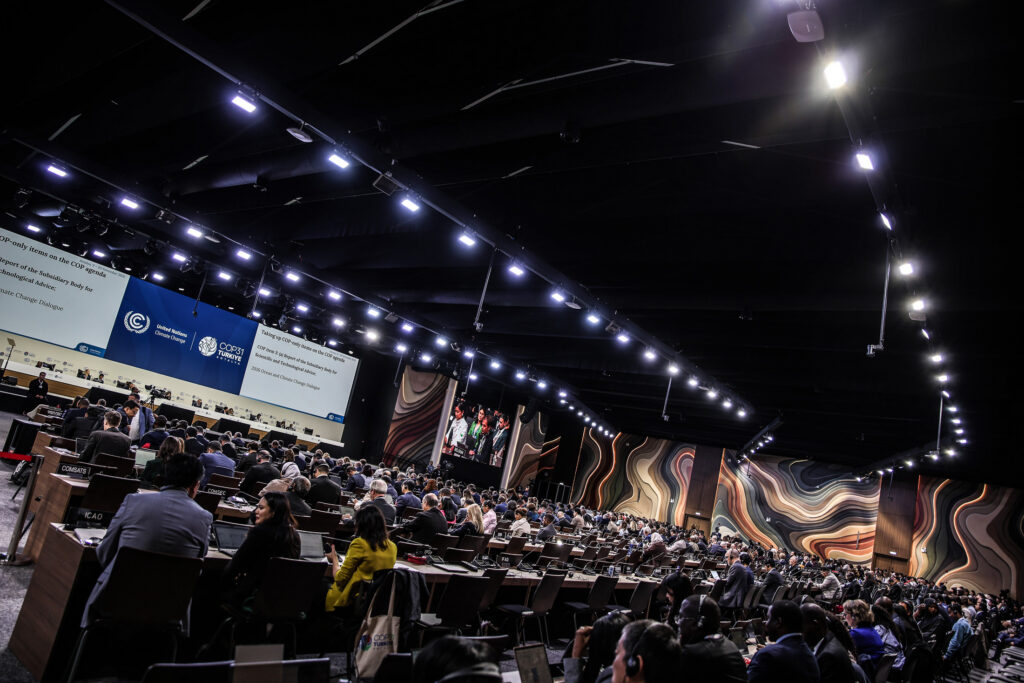
Climate finance became the first test of COP31 in Antalya. The conference opened on November 9 and runs to November 20. Before negotiators could start, Parties had to settle a dispute over the agenda itself, and the argument was about money: how much developed countries will provide, and how fast developing countries can actually draw on it.
For business, the outcome matters on two fronts. The talks shape the public finance that de-risks private projects in emerging markets, and they keep returning to how private capital is counted toward the targets agreed in Baku.
An agenda fight before the first session
According to the Earth Negotiations Bulletin, Parties adopted the agendas of the governing and subsidiary bodies after the opening statements on November 9, and a contact group on long-term finance launched negotiations immediately. It is co-chaired by Isobel Bartholomew of the United Kingdom and Yolando Velasco of the Philippines.
Business Standard reported that the dispute centered on the Climate Finance Work Program, which the G77 and China want to use to discuss how developed countries will meet their obligation to provide finance under Article 9.1 of the Paris Agreement. The paper reported resistance from the European Union and the Umbrella Group. It also reported that climate-related trade measures, including the EU’s Carbon Border Adjustment Mechanism, were not added as a separate agenda item, though discussion is expected to continue through other channels.
What the presidencies are asking for
UN Climate Change Executive Secretary Simon Stiell set the terms in his opening statement. “Agreements on finance will give us clarity on how to achieve the 300 billion and 1.3 trillion commitments, without reopening previous agreements,” he said. Those figures refer to the goal agreed in Baku of at least $300 billion a year for developing countries by 2035, and a wider call for $1.3 trillion a year from public and private sources.
Chris Bowen, the Australian minister serving as COP31 President of Negotiations, focused on access. “The countries that need climate finance the most, are getting it the least,” he said. His list of mandated work includes the Climate Finance Work Program, follow-up on the tripling of adaptation finance, the transition of the Adaptation Fund, and Article 2.1c, the Paris goal of making finance flows consistent with low-emission, climate-resilient development.
Bowen pointed to the Access to Finance Statement and Action Plan for small island developing states and least developed countries, launched at the Pacific Pre-COP. A concept note published by the COP31 presidencies describes it as an Action Agenda initiative outside the formal negotiations, aimed at reforms that “reduce transaction costs, shorten approval timeframes and strengthen country ownership.”
COP31 President Murat Kurum of Türkiye described the presidency’s Climate Implementation Bridge in similar terms. “We will connect investors with projects that need funding,” he said.
What to watch
Three signals matter for companies with exposure to emerging-market projects. First, whether the long-term finance text says anything new on private mobilization and how it is counted. Second, whether Article 2.1c work moves toward guidance that banks and insurers would be expected to follow. Third, whether the trade dispute resurfaces in the presidency-led consultations as the talks move into week two.
Sources
- UN Climate Change: “COP31 must supercharge solutions,” opening statements of Simon Stiell, Murat Kurum and Chris Bowen (November 9, 2026)
- UN Climate Change: COP31 Access to Finance Declaration for SIDS and LDCs, concept note (August 27, 2026)
- Earth Negotiations Bulletin (IISD): Highlights and images for November 9, 2026
- Business Standard: COP31 opens with climate finance clash as rich, developing nations spar (November 10, 2026)







