








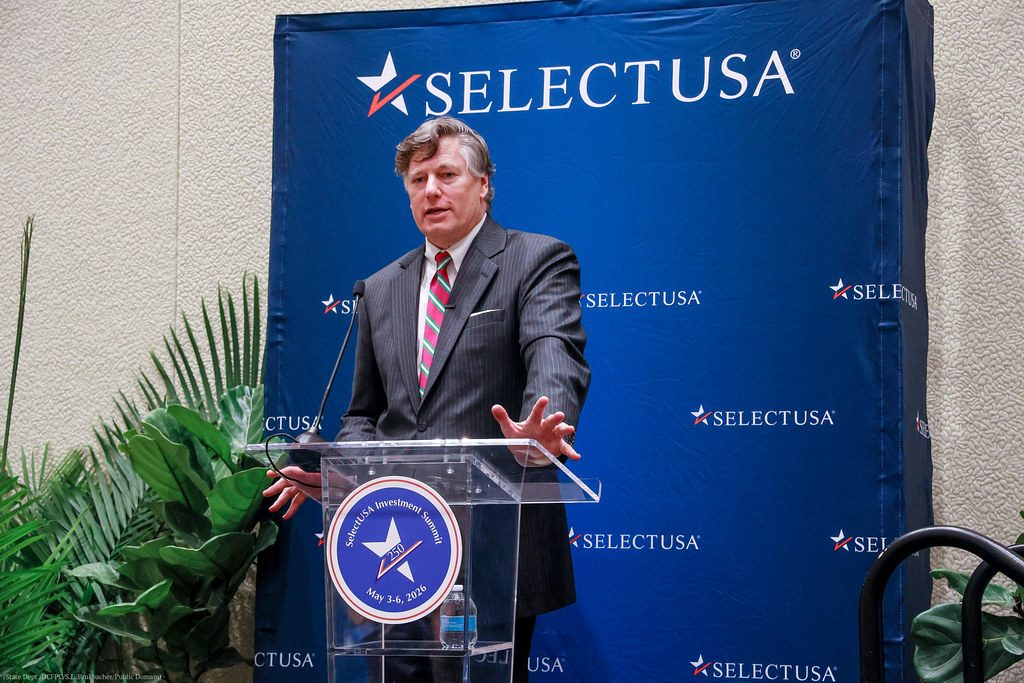
The B20 USA Summit, set for November 9–11, 2026, at The Wharf in Washington, D.C., is being built around a goal that sets it apart from earlier B20 cycles: drawing foreign direct investment into the United States. For companies weighing U.S. expansion, and for the state and local agencies competing for that capital, the summit is designed as a place to meet and do business, not only to draft policy recommendations.
A deal-making format
In an April 15 op-ed, U.S. Chamber of Commerce President and CEO Suzanne P. Clark said the Chamber wants the B20 to be “a platform built by and for the business community itself,” with a new emphasis on “inking deals and attracting foreign investment to America.” She argued that government sets the framework but cannot mobilize private capital at scale on its own.
The Chamber’s summit explainer, updated August 14, says the program will include a “Hall of States and Cities” and an “Embassy Row” to connect foreign investors with U.S. communities and businesses. The explainer says G20 nations account for two-thirds of the $5.7 trillion in foreign direct investment in the United States and that the B20 aims to grow that figure. The Chamber’s published materials do not yet list which states, cities or embassies will take part.
The policy track runs alongside the investment program. Four task forces, on economic growth, trade, energy and innovation, are preparing recommendations for G20 governments. Clark has said these themes align with the U.S. presidency’s G20 agenda, which the official G20 site summarizes as limiting regulatory burdens, securing affordable energy supply chains and advancing AI and emerging technologies.
What the latest federal data show
The most recent official figures come from the Bureau of Economic Analysis (BEA). On July 21, 2026, BEA reported that the foreign direct investment position in the United States increased $266.0 billion to $5.86 trillion at the end of 2025. Manufacturing accounted for 42.8 percent of the total, or $2.51 trillion, with chemical manufacturing the largest component. By country of foreign parent, Japan led at $776.3 billion, followed by the Netherlands, Canada and the United Kingdom.
New investment also rose. In a June 10 release, BEA said expenditures by foreign direct investors to acquire, establish or expand U.S. businesses totaled $232.2 billion in 2025, up 49.5 percent from 2024. Japan, Germany and Canada were the largest sources by country of ultimate beneficial owner. California, Texas and Pennsylvania received the largest first-year expenditures. Manufacturing made up just over half of the total.
What to watch
Registration for the invitation-only summit closes October 16, according to the event page. The Chamber has said the summit will end a year-long process in which delegates present formal policy recommendations to government partners. G20 leaders meet in Miami on December 14–15, about five weeks after the B20. Public affairs teams will want to see whether the Chamber reports investment announcements from the summit and how the task force recommendations are reflected in the leaders’ texts.
Sources
- U.S. Bureau of Economic Analysis: Direct Investment by Country and Industry, 2025 (July 21, 2026)
- U.S. Bureau of Economic Analysis: New Foreign Direct Investment in the United States, 2025 (June 10, 2026)
- G20 Miami 2026: U.S. G20 Priorities
- G20 Miami 2026: Events Calendar
- U.S. Chamber of Commerce: B20 USA 2026
- U.S. Chamber of Commerce: What to Know About the B20 USA Summit and Why It Matters
- U.S. Chamber of Commerce: B20 USA: Strengthening Global Partnerships, Unlocking Investment, Driving Growth At Home (April 15, 2026)
- U.S. Chamber of Commerce: B20 USA Summit event page







