






Group of Nations SUMMITSSolutions Through Inclusivityby Group of Nations

Publisher of the first-ever G7 Summit publication, Denver 1997

See where your company fits

A question for your company

Which analysis on this page could your company add a solution to?

Share your answer over a virtual coffee & a chat →
An Official Publication of America250. Declaring Freedom: the founders and the birth of a nation. Order your copy at shop.groupofnations.com An Official Publication of America250. Icons of the Open Road: Route 66 and landmarks from all 50 states. Order your copy at shop.groupofnations.com An Official Publication of America250. Gridiron Evolution: America’s game, from Canton to the world. Order your copy at shop.groupofnations.com An Official Publication of America250. To the Moon and Beyond: America’s space legacy. Order your copy at shop.groupofnations.com
Official America250 Commemorative Posters in Full Color, Old Style and Black & White, 18 x 24 in. Order at shop.groupofnations.com
With congratulations on America’s 250th Anniversary, from JMI-IBNF, PEACE and the Global Alliance CouncilAdvertisement
Group of Nations supports Birmingham Care Group as its charity of choice. Donate now at birminghamcaregroup.org Sea Menace, a feature documentary on sargassum. One fisherman. One bloom. One ocean. One world connected. Supported by Groupofnations.com. Donate now at gofundme.com/f/support-sea-menace

Analysis · APEC · Investment disputes

APEC researchers make the case for settling investor grievances early

An APEC Policy Support Unit analysis argues that one-stop grievance mechanisms can stop regulatory friction from turning into costly investor-state disputes.

October 21, 2026 · 3 min read

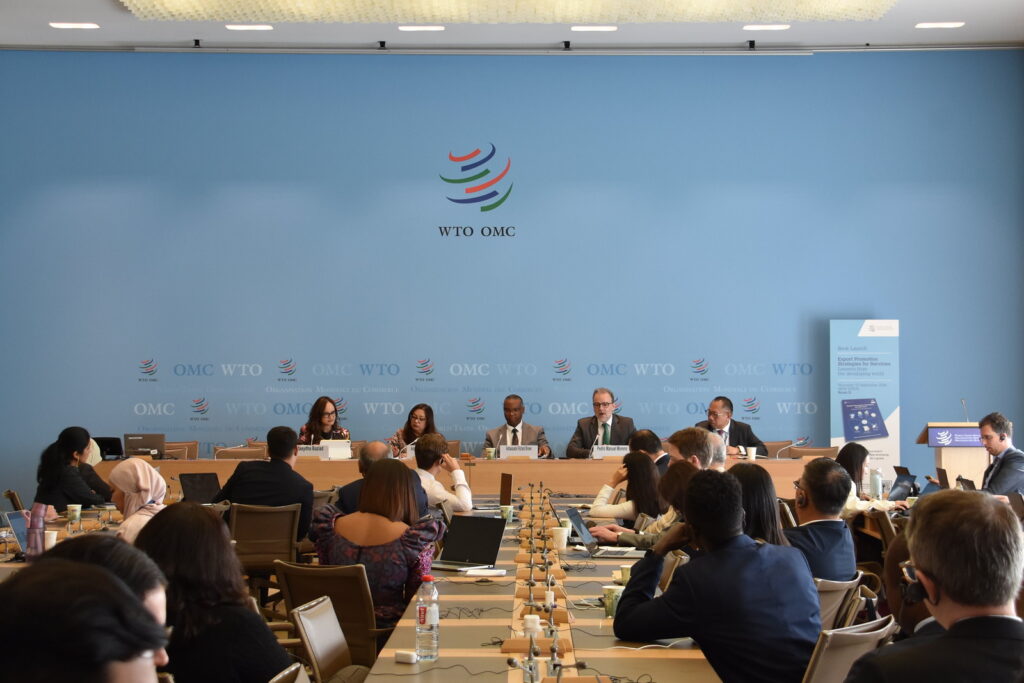
UNCTAD and APEC session at the WTO Public Forum in Geneva
UN Trade and Development and APEC hold a session on services in a digital world at the WTO Public Forum in Geneva, September 17, 2026. Photo: UN Trade and Development (UNCTAD), CC BY-SA 4.0

As APEC economies compete for investment while supply chains shift, the APEC Policy Support Unit (PSU) is pressing a practical point: many investment disputes can be prevented. In a blog post published October 15, 2026, PSU researcher Yan-Rong Chang and senior analyst Akhmad Bayhaqi write that “small regulatory frictions can escalate into costly investment disputes,” and that governments and firms both have a role in catching them early.

The post draws on a PSU report published in January 2026, Research and Survey on the Dispute Prevention and Mitigation System in APEC Economies. It comes weeks before APEC Economic Leaders’ Week in Shenzhen in November, under a host-year agenda built on openness, innovation and cooperation.

How disputes start

The authors identify inconsistent guidance, delayed administrative processes and unpredictable policy as common triggers. They argue that investors favor locations where government is reliable, predictable and fair, and that this matters more as supply chains reconfigure and competition for high-value projects grows. In extreme cases, sudden regulatory changes that affect treaty or tax-stability commitments can cause investor losses, and unresolved tensions can end in expropriation or project closures.

Once a grievance hardens, investors can go to domestic courts or to investor-state dispute settlement (ISDS) under investment treaties and free trade agreements, through ICSID or UNCITRAL. The authors note that these proceedings are often lengthy and expensive.

What prevention looks like

The January report examines mechanisms that act as one-stop contact points for foreign investors’ grievances. These bodies receive complaints directly and can act before a formal dispute begins. The study reviews the legal frameworks behind them, draws on interviews with officials who run them and includes input from the business community.

It finds that well-designed mechanisms can speed resolution, reduce legal costs and risks, make government processes easier to navigate and support a more stable business environment. It sets out a checklist of issues for economies designing or improving such a body. Institutional models vary, from semi-independent bodies to agency-based units and coordination platforms. “There is no single model that works for everyone,” the blog says. The authors add that these mechanisms complement formal routes such as ISDS rather than replace them.

What it means for companies

The blog assigns part of the responsibility to firms. It points to structured communication channels with governments, transparent relationships with officials and internal grievance mechanisms. Grievances often first surface in informal talks, public consultations or media reports, and the authors argue that acting on those early signals keeps costs from multiplying.

For public affairs teams, the research is a reminder to know which contact points exist in each host economy before an issue escalates. The authors conclude that “building trust early may prove even more important than resolving disputes later.”


Sources

Source: www.apec.org

Would you be against a virtual coffee & a chat? A cup of coffee framed by G7, G20, APEC and COP
Chris Atkins
Chris AtkinsPresident & Founder, Group of Nations

Would you be against a virtual coffee & a chat to see where your company fits?

Schedule your virtual coffee →

Click the image to order your virtual coffee & a chat. Pick a time that suits you; the video link comes with your calendar invitation.

More on APEC

APEC page →

Read by ministers and government officials, delegations, embassies, CEOs and NGOs

We explain what was decided. Your company can show business leaders, delegations and NGOs how it gets done.

Clients that have shared their solutions

SamsungMastercardDeutsche BankPfizerBMW
Would you be against a virtual coffee & a chat to see where your company fits?
Front cover: The Advocacy Advantage by Chris Atkins

Free book · by Chris Atkins

The Advocacy Advantage

How the world’s top executives shape global stories

We’ll email you the book. Your address stays with Group of Nations.

Summit alerts

Know what is being published, before it is published.

A short note ahead of each summit — the edition in production, the deadline for inclusion, and what the presidency has put on the agenda. No more than one a month.

We publish for governments and Fortune 500 companies. Your address is used for these alerts only, and never sold.





