







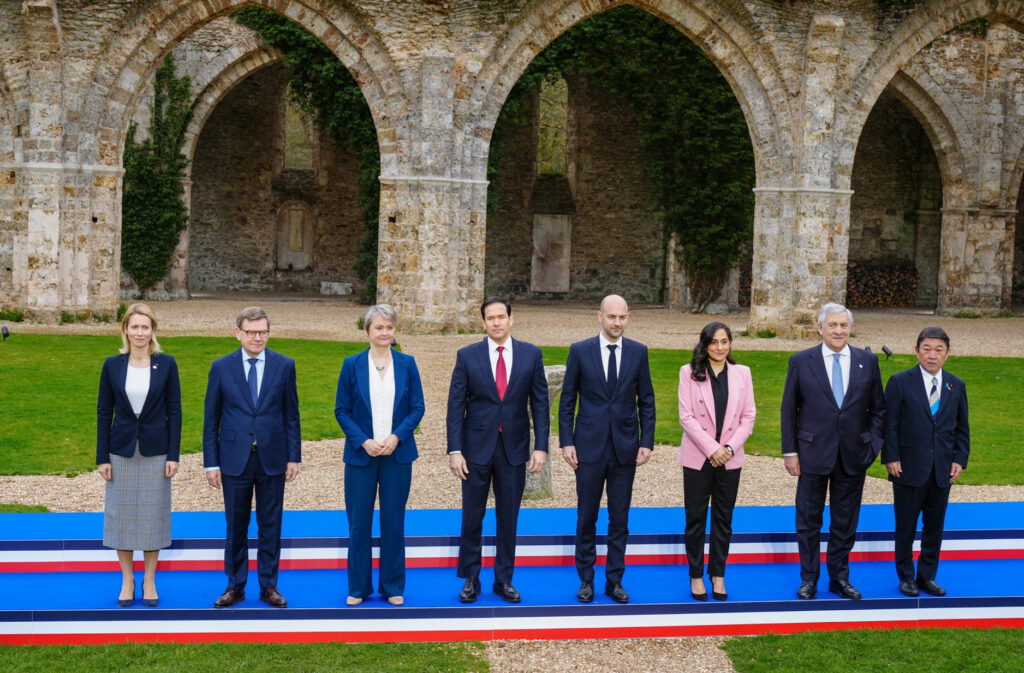
G7 foreign ministers meet in Paris on November 9 and 10, 2026, with an agenda that France’s foreign ministry published on November 6. It sets four priorities: crisis diplomacy and energy security, port security against drug trafficking, humanitarian supply chains, and the safety of artificial intelligence.
What is new since the venue moved from Marseille to Paris is the agenda itself, along with the list of invited partners. Several items touch business directly: energy supply diversification, the security of commercial ports, the logistics of humanitarian aid and government coordination on frontier AI.
This is the second formal two-day foreign ministers’ meeting under France’s G7 presidency. The first was held at Vaux-de-Cernay in March 2026. Ministers are to assess progress made since then.
Crises, energy and the Indo-Pacific
The first priority covers support for Ukraine “in terms of capacity, finance and energy,” stabilizing the Middle East, and diversifying and securing energy supplies. The ministry also lists Sudan, the Horn of Africa, Venezuela, Cuba and Haiti, and a free and open Indo-Pacific founded on the rule of law. The stated aim is a convergence of views and a coordinated response to crises.
Ukraine’s energy and reconstruction needs have a related event. France is holding a donor conference in Paris on November 9 with the European Bank for Reconstruction and Development (EBRD) and the Ukrainian authorities on restoring the containment arch at Chornobyl, which the ministry says was severely damaged by a Russian strike in 2025.
Ports, aid logistics and AI
The second priority is maritime and port security. The G7+ Ports Network, announced at the Évian leaders’ summit in June, will meet for the first time in Marseille while ministers are in Paris. Its purpose is to share practices on securing ports in G7 and partner countries against drug trafficking. For shippers, terminal operators and logistics firms, that is where any new expectations on port security would surface.
The third priority is making humanitarian support more effective, including streamlining humanitarian supply chains and work on food security and nutrition. The ministry says the World Food Programme’s Executive Director, Luke J. Lindberg, will attend. It also says the presidency has begun mapping humanitarian stocks worldwide to speed emergency response.
The fourth priority is AI security. The agenda links it to G7 work that began at Évian and continued at the UN Security Council in September 2026. The ministry says the G7 must respond to the acceleration of frontier AI models in a way that preserves innovation while ensuring safe development and deployment.
Who is at the table
France has invited Brazil, Egypt, the Republic of Korea, Saudi Arabia and Ukraine. The ministry describes them as partners that have contributed to the presidency’s discussions and deliverables since the start of the year.
The agenda page does not say whether ministers will issue a joint statement. Readers following the meeting should watch the French foreign ministry’s G7 pages for any chair’s summary or joint text after November 10.







