







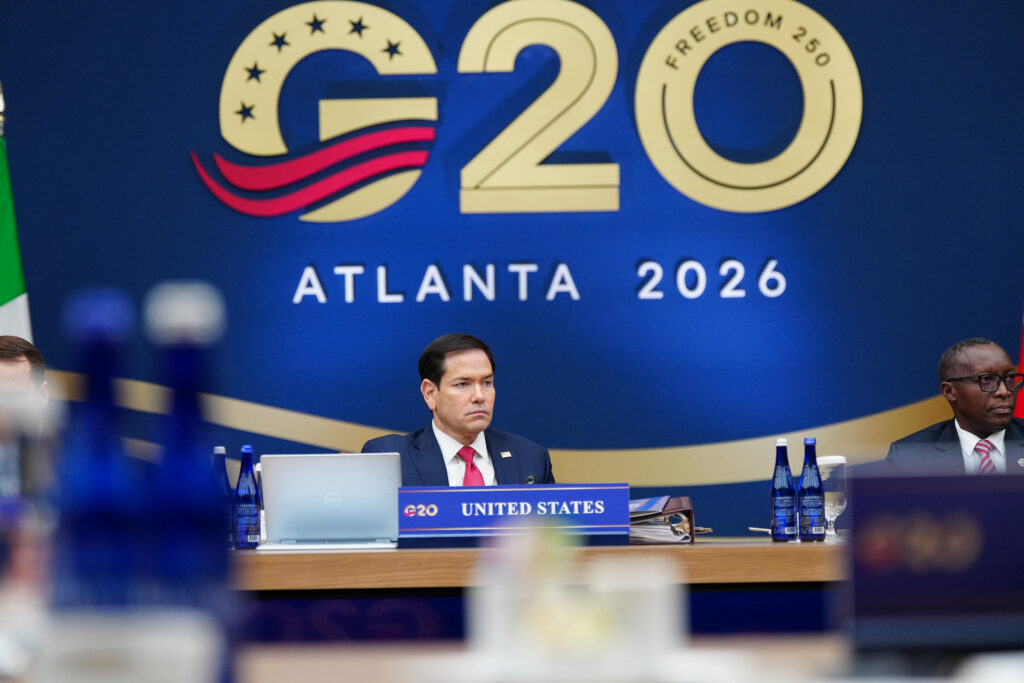
G20 foreign ministers ended their Atlanta meeting on October 31 with a chair’s statement rather than a joint communiqué. The text sets out the U.S. presidency’s position on energy, supply chains and sea lanes, but it does not bind members. For companies planning around the Miami summit, it is the clearest sign yet of what the leaders’ text may and may not contain.
The Associated Press reported that the statement records no agreements. Ministers divided over Russia’s war in Ukraine, and the Jiji Press reported that the situation in Iran also stood in the way of a joint text. Diplomats told the AP that a chair’s statement had long been the plan. The traditional group photo was canceled after European objections to including Russian Foreign Minister Sergey Lavrov.
Secretary of State Marco Rubio, who chaired, said he would not pretend that “we are close to finding universally accepted solutions.” He said members agreed the problems were serious, and that some were working together on supply chains and critical minerals.
What the text says on energy
The energy section calls for abundant, affordable supply and describes demand growth driven by electrification, cooling and digitalization. It names civil nuclear energy, including small modular and micro reactors, as a contributor to supply, while noting that nuclear may not suit every country. It states that every country “is entitled to make its own sovereign choices.” Rubio said climate change was not on the agenda, though Brazil and others raised it.
What it says on supply chains
The statement groups fertilizer, raw materials and critical minerals together. It says resilience begins with sharing information, improving transparency and mobilizing investment, and that updated permitting and regulation can help.
It speaks directly to the private sector. It says governments should commit to close partnerships with companies to advance processing, refining and recycling of critical minerals. It also says stable domestic regulation and durable contracts, particularly for long-term agreements, underpin the required investment.
What it means for Miami
Atlanta follows a mixed record for the U.S. presidency. Trade ministers in Milwaukee reached consensus on food coercion, but not on forced labor, and the chair said a handful of members rejected a cooperative path on excess capacity. Energy ministers in Houston and innovation ministers in Raleigh-Durham published their own texts.
Rubio said the first step was shared recognition of the problems. Work on solutions now moves to the leaders’ level. The presidency lists a fourth sherpa meeting in Miami on December 10 to 12, followed by the Leaders’ Summit on December 14 and 15. The statement closes by looking ahead to that summit and to the United Kingdom’s presidency in 2027.
Sources
- U.S. Department of State: G20 Chair’s Statement, G20 Foreign Ministers’ Meeting
- U.S. Department of State: Secretary Rubio at a press availability, Atlanta
- G20 Miami 2026: U.S. presidency site, events and working groups
- USTR: Chair’s Statement of the G20 Trade Ministerial
- Associated Press via DTN: G20 foreign ministers end Atlanta meeting without consensus on key issues
- Jiji Press via Nippon.com: G20 foreign ministers end meeting without joint statement







