









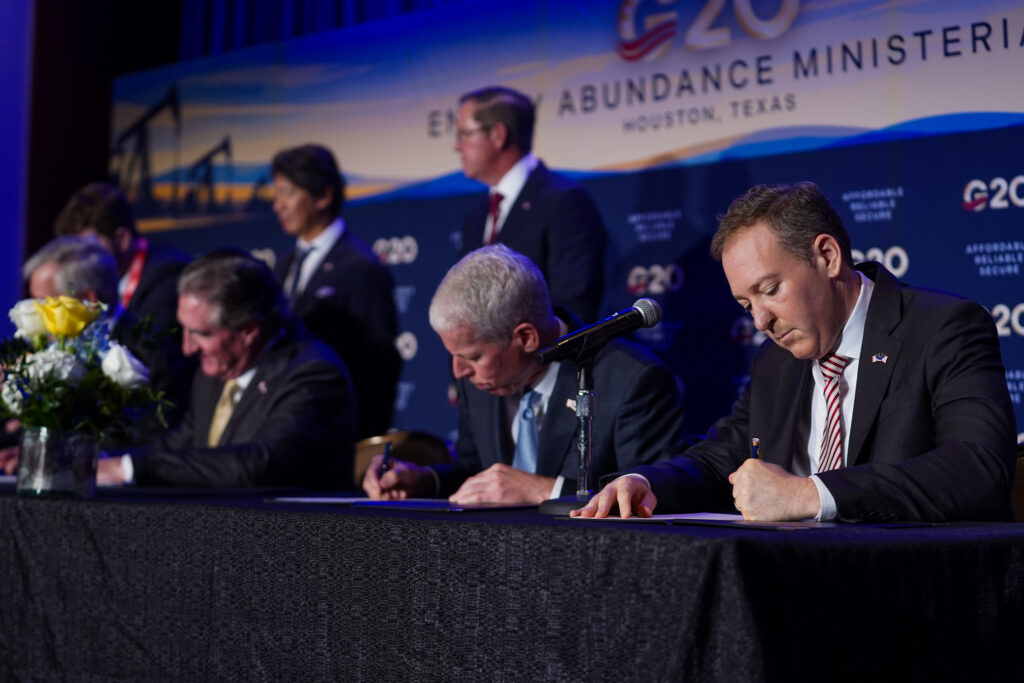
G20 energy ministers have agreed a text on permitting and regulatory efficiency that will sit in the record when leaders meet in Miami on December 14–15, 2026. The text commits members to share practices and to explore digital tools, including artificial intelligence, to speed approvals. It sets no targets, deadlines or review dates. For companies that develop, build or finance energy infrastructure, it shows where G20 governments are prepared to cooperate on approvals, and where they are not.
Permitting is one of three pillars of the U.S. presidency’s Energy Abundance Working Group, alongside energy security and affordable baseload, and critical minerals and resilient supply chains. According to the White House, ministers reached consensus on the permitting text and three other outcomes when the Energy Abundance Ministerial concluded in Houston on September 16, 2026.
What ministers agreed
In the statement, ministers “affirm the importance of effective and efficient national and domestic permitting and regulatory approaches” for enabling energy infrastructure, “respecting national sovereignty.” They state that “effective, efficient and predictable permitting processes are essential to facilitating economic growth and resilience.”
The stated aim is to improve efficiency, clarity and predictability “without compromising regulatory effectiveness and environmental protections.” Ministers say this could include “exploring the secure and trustworthy use of artificial intelligence and other digital tools to enhance administrative coordination and efficiency,” in line with domestic laws, data governance frameworks and risk management approaches. The text also points to transparency, interoperability and, where justified, sharing relevant public data.
The statement lists six voluntary G20 actions. Members will exchange information on universal energy access; share experience on how different permitting processes interact; showcase process improvements; encourage energy development in line with national circumstances; hold symposia, webinars and workshops; and support capacity building and technical assistance, in particular for developing countries. It also cites experience working with subnational governments.
What it leaves out
The text contains no timelines or numerical goals. It does not name specific asset types such as transmission lines, pipelines or power plants, and it does not ask any international organization to track progress. Delivery depends on how members use the exchange mechanisms it describes.
The statement was agreed alongside a permitting symposium hosted by the U.S. presidency that, in the statement’s words, showcased “innovations and successes from the public and private sectors.” The White House also said the Environmental Protection Agency used the ministerial to announce the repeal of most greenhouse gas requirements for U.S. power plants. That is a domestic U.S. measure, not a G20 commitment.
How it links to the finance track
The same theme runs through the finance track. In their Asheville chair’s statement of September 1, 2026, finance ministers and central bank governors listed “regulatory and administrative burdens” among the common impediments to growth. That text was a chair’s statement rather than a consensus communiqué: a footnote records that China objected to four of its paragraphs.
For business, the practical openings are the information exchanges and workshops the permitting text describes. Companies with projects in several G20 markets may find them a channel for comparing approval practices, including the use of digital permitting systems.
Sources
- G20 Energy Abundance Ministerial Statement, Pillar II: Permitting and Regulatory Efficiency (whitehouse.gov)
- The White House: G20 Energy Abundance Ministerial concludes with four consensus outcomes (September 21, 2026)
- U.S. Treasury: G20 Chair’s Statement, Second Meeting of G20 Finance Ministers and Central Bank Governors, Asheville (September 1, 2026)
- G20 Miami 2026: U.S. presidency priorities and working groups







