








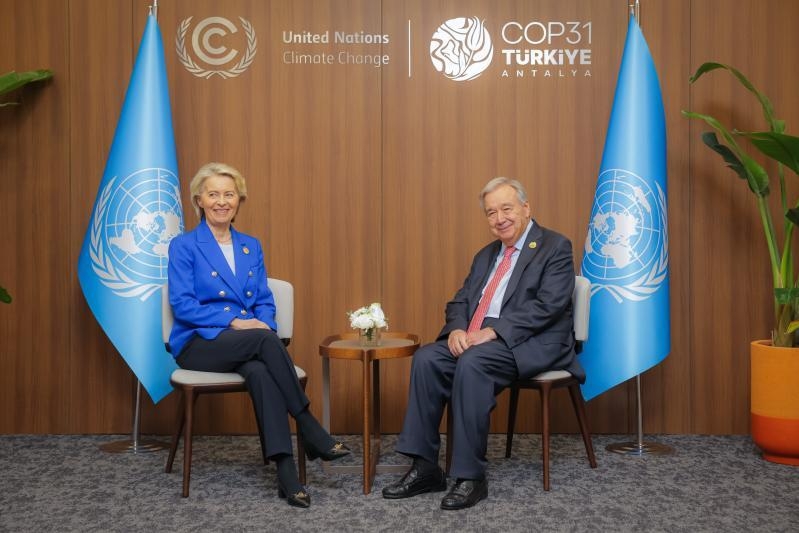
The UN Environment Programme (UNEP) has published its Emissions Gap Report 2026, subtitled “The Point of Return,” as negotiators meet at COP31 in Antalya, Türkiye, from November 9 to 20, 2026. The report, released on October 21, 2026, starts from the position that global warming is set to exceed 1.5°C above pre-industrial levels. It then asks how small and how short that overshoot can be kept. For executives and delegates following COP31, its figures are a reference point for the debates on national climate plans and the next Global Stocktake.
The numbers behind the overshoot
UNEP models a “lowest possible” overshoot scenario. In it, peak warming around the middle of the century is held to 1.7 to 1.8°C, and temperatures return to 1.5°C or below by 2100, with about a 50 percent chance.
To reach that pathway, global greenhouse gas emissions would need to fall by 18 percent by 2030, 45 percent by 2035 and 69 percent by 2040, all compared with 2025 levels. Full delivery of current Nationally Determined Contributions (NDCs) would cut emissions by only 5 to 8 percent by 2030 and 11 to 15 percent by 2035.
The report projects warming of 2.8°C this century if current policies continue, and 2.6°C if all NDCs are delivered. UNEP says these outcomes are worse than last year’s projections because of the withdrawal of the United States from the Paris Agreement and revised estimates of historical emissions. Even if all NDCs and net-zero targets are met, warming would reach 2.1°C. UNEP estimates that every five years of carbon dioxide emissions at current levels adds around 0.1°C to peak warming.
The scenario also depends on removing and permanently storing roughly 320 gigatonnes of carbon dioxide over the century. The report describes the chances of achieving this as uncertain.
Evidence that policies cut emissions
The report draws on more than 220 policy evaluations. Policies in the electricity sector reduced emissions by an average of 9 percent, and economic instruments such as cap-and-trade schemes and carbon taxes achieved reductions of 5 to 13 percent across sectors. UNEP also notes that global renewable electricity capacity has grown three times faster than anticipated since the Paris Agreement was adopted, with solar build-out growing seven times faster.
UN Secretary-General António Guterres said in a message on the report: “Overshoot is not surrender.”
What it means for the second Global Stocktake
The report offers a preliminary assessment of how goals from the first Global Stocktake could be extended to 2035 and 2040. By 2035, this would mean at least tripling renewable electricity capacity and cutting the energy intensity of GDP by at least 30 percent, compared with 2025. By 2040, the figures rise to at least 4.5 times and 40 percent.
For fossil fuels, the assessment points to cutting the shares of coal, oil and gas in total energy supply by at least 55, 15 and 5 percent by 2035, and by at least 75, 30 and 35 percent by 2040. Coal-fired power would fall by at least 75 percent by 2035 and be effectively phased out by 2040. Methane emissions would be at least 25 percent lower by 2035 and 40 percent lower by 2040.
These are UNEP estimates, not agreed targets. Whether governments adopt any of them is a matter for the negotiations.







