








On November 9, 2026, President Emmanuel Macron convened a meeting on artificial intelligence and security in Paris as a follow-up to the June 17 session with AI lab leaders at the G7 summit in Évian. It produced the Paris Call for the Security of Artificial Intelligence, a voluntary text on how frontier AI risks should be tested, reported and governed. For companies that build, deploy or buy advanced models, it signals the evaluation, incident-reporting and liability expectations that several governments want to set.
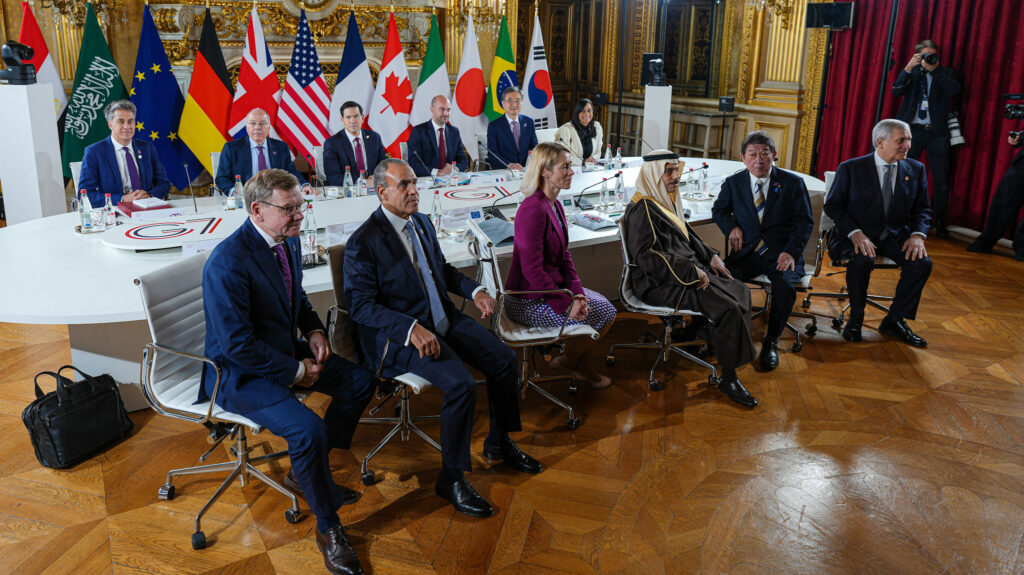
The same day, G7 foreign ministers meeting in Paris held a session on artificial intelligence, which shows how far the text has, and has not, traveled within the G7.
Who took part and who signed
According to the Élysée, the meeting brought together leaders or representatives of Bahrain, Canada, Finland, Japan, Norway, the Netherlands, the United Kingdom and Sierra Leone, the U.S. Treasury Secretary, the United Nations and the OECD. Companies present included Anthropic, Black Forest Labs, Hugging Face, Microsoft, Mistral AI, OpenAI and Sakana AI, along with researcher Yoshua Bengio.
The published text lists six signatory states: Bahrain, Canada, Finland, France, Norway and the Netherlands. Japan and the United Kingdom attended but are not listed as signatories, and neither is the United States. Ten companies signed: Anthropic, Black Forest Labs, Cohere, Domyn, Hugging Face, Microsoft, Mistral AI, OpenAI, Sakana AI and Synthesia. The Élysée says the declaration remains open to new supporters.
What the text asks for
The call cites the Évian G7 meeting, the G7 Hiroshima AI Process, the Seoul commitments and a September 23 UN Security Council meeting as its foundations. Its main commitments are:
- a common framework to evaluate and manage frontier risks, including cyber, chemical, biological, radiological and nuclear risks and loss of control, with non-sensitive results published in a standard format in a public repository;
- faster sharing of information on serious incidents, and early warning;
- secure and confidential channels for whistleblowers;
- mechanisms that let developers halt a model’s operation; and
- legal frameworks that clarify liability for large-scale harm.
Participants also agreed on three points: independent evaluators, aligned standards for evaluation and major-incident reporting, and clarity on each actor’s responsibility. For legal and compliance teams, the liability and whistleblower items go further than earlier voluntary G7 reporting.
The G7 picture
Japan’s Ministry of Foreign Affairs says G7 foreign ministers, joined by Brazil, the Republic of Korea, Saudi Arabia and Egypt, called for the safe and trustworthy development of frontier AI and for stronger security of undersea cables. Japan’s summary records no adopted text on AI.
The U.S. position differs in emphasis. Speaking to reporters in Paris on November 9, Secretary of State Marco Rubio said, “we’re very concerned about these global institutions trying to regulate something that would stifle innovation.” He also acknowledged the risks: “You worry about how it can be used to create biological or chemical weapons.”
For multinationals, the result is a set of expectations that applies unevenly. Signatory companies have made voluntary commitments, some G7 governments back the framework, and others, including the United States, have not joined it. Whether more governments sign before the end of France’s presidency is the next thing to watch.
Sources
- Élysée: Appel de Paris pour la sécurité de l’intelligence artificielle, November 9, 2026 (French)
- Élysée: Communiqué on the AI and security meeting, November 9, 2026 (French)
- Ministry of Foreign Affairs of Japan: G7 Foreign Ministers’ Meeting, Session 2 on artificial intelligence
- U.S. Department of State: Secretary Rubio’s remarks to the press, Paris, November 9, 2026







