







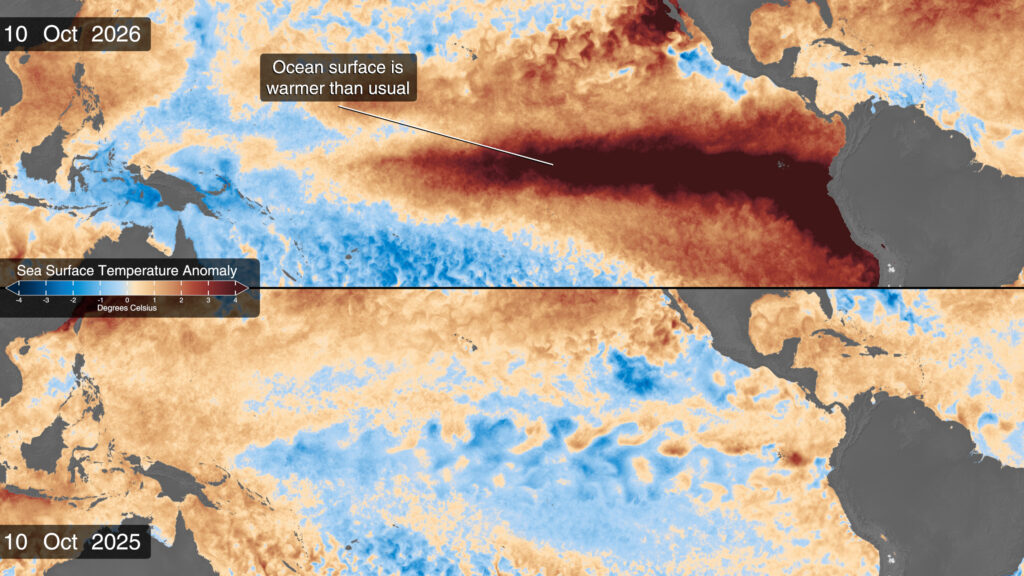
The World Meteorological Organization released its State of the Climate Update for COP31 on November 9, the opening day of the Antalya conference. It is one of the main scientific inputs on current conditions in front of delegates, and it gives companies a fresh reading on physical climate risk to operations, supply chains and insured assets.
The headline: 2026 will be one of the four warmest years on record, and an El Niño that has been intensifying since August is expected to reach record strength by December.
The numbers
The WMO puts the global mean near-surface temperature from January to September 2026 at 1.47°C above the 1850–1900 average, with a margin of plus or minus 0.13°C. That is comparable to the full-year averages for 2025 and 2023 and below the 2024 record of 1.55°C. The agency says the full-year figure is likely to be higher than the nine-month average, because El Niño typically adds around 0.1°C to 0.2°C to annual global temperatures.
The past four years, 2023 to 2026, are the four warmest on record. Global mean sea level reached a record high in 2026. Preliminary data through July point to a tenth consecutive year of record ocean heat content. Concentrations of carbon dioxide, methane and nitrous oxide all reached record highs in 2025.
Why it matters for business
The update lists 2026 events with direct economic effects. It cites preliminary estimates of more than 30,000 excess deaths from European heat waves, drought and wildfires, and an estimated 146.5 million people in India exposed to extreme heat in an April heat wave. A Himalayan glacier collapse and flash flood in late August killed more than 1,300 people and, the WMO says, had a massive impact on Nepal’s economy.
The agency also flags agriculture. It says El Niño is already increasing risks for farming in key seasons, especially for rain-fed systems in areas with high food insecurity. That matches the APEC Policy Support Unit’s August outlook, which named an intensifying El Niño as a risk to food prices across the Asia-Pacific.
“We are supercharging our weather and El Niño will be a risk multiplier,” said WMO Secretary-General Celeste Saulo.
Early warnings and the finance ask
The WMO reports that the number of countries with multi-hazard early warning systems rose from 56 in 2015 to 136 in 2025. At COP31 it is promoting the WMO Commons, a proposal for financing weather, climate and water information services. The final State of the Global Climate 2026 report is due in March 2027.
In the negotiations, the science feeds into the Global Goal on Adaptation and the second global stocktake, which Stiell said takes place two years from now.
Sources
- World Meteorological Organization: State of the climate in 2026 gives new meaning to phrase “off the charts” (press release, November 9, 2026)
- World Meteorological Organization: State of the Climate Update for COP31
- World Meteorological Organization: WMO at COP31
- APEC Policy Support Unit: APEC Sees 3.2% Growth in 2026 as Exports Jump, Inflation Accelerates (August 27, 2026)
- UN Climate Change: “COP31 must supercharge solutions,” opening statements (November 9, 2026)







